Comparisons
Starting an IPTV Reseller Business in Canada: Credits, Pricing and Support (2026)
Thinking of becoming an IPTV reseller in Canada? How credits work, real margin maths from current prices, what to charge, and the support customers expect.
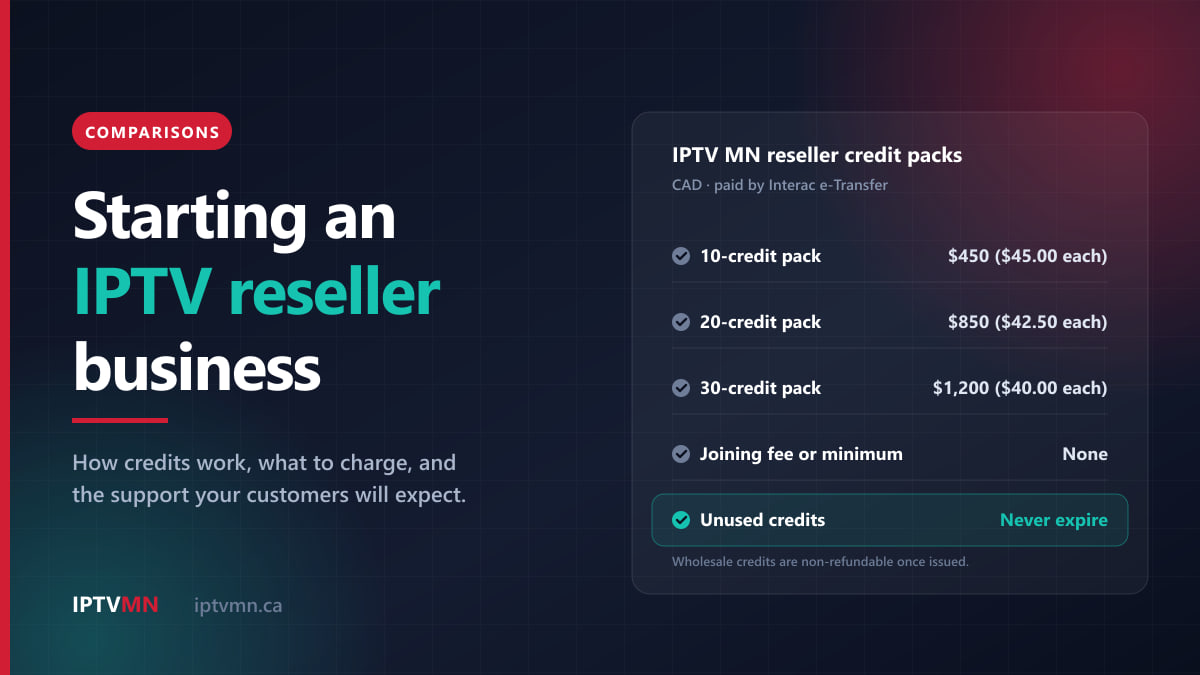
Starting an IPTV reseller business in Canada means buying service credits at wholesale, using them to create subscriptions for your own customers, and keeping the difference between what you pay and what you charge. With IPTV MN there is no joining fee and no monthly minimum, and the smallest credit pack costs $450.
Whether it is worth doing depends less on the wholesale price than on two things people underestimate: your customers can see public retail prices, and support takes up your evenings. This guide works through both with real numbers, so you can decide before you spend anything.
The short answer
- How it works: you buy credits, create customer lines in your own panel and set your own prices. IPTV MN runs the network and stays behind you. Your customers deal with you.
- What it costs to start: 10 credits for $450, 20 for $850 or 30 for $1,200, paid by Interac e-Transfer. Credits never expire, but they cannot be refunded once issued.
- What you can earn: the packs are listed at about one year of service per credit, so a one-screen year costs you $40 to $45 in credits. Sold at IPTV MN’s own $78 retail price, that leaves $33 to $38 per customer per year.
- What the job really is: customer support. Logins, app installs, renewals and “it stopped working” messages come to you first.
- Who it suits: someone who already sets up TVs for other people, such as a repair shop, a community organiser or the handy neighbour, and wants to be paid for it.
- Who it does not suit: anyone looking for passive income, or planning to win customers by undercutting on price alone.
How does an IPTV reseller business work?
A reseller sits between the network and the viewer. IPTV MN runs the servers, the channels and the technical side. You run the customer side: you find people, set them up, take their payment, renew them and answer their questions. In return, you buy service at wholesale rates and charge your own retail price.
The tool that connects the two is the reseller panel, a dashboard where you manage every line you sell. The IPTV MN reseller programme page describes what it does:
- create a customer line in seconds, active immediately;
- renew or extend a line without changing the customer’s login, so they keep their favourites and settings;
- change the number of connections on a line, reset passwords and cancel lines;
- see which lines are active, which are online right now and which are close to expiring;
- create sub-reseller accounts beneath yours and allocate credits to them.
Your customers know they are buying from you. You sell under your own name, and IPTV MN does not contact your customers directly. Here is how the work divides:
| Task | You, the reseller | IPTV MN |
|---|---|---|
| Servers, channels and the network | Not your job | Runs it end to end |
| Creating, renewing and cancelling lines | You, in the panel | Not involved |
| Prices, payment and customer terms | You set them | Not involved |
| Day-to-day customer help | You, as first line | Priority technical backup to you |
| Network faults and maintenance | Report what you see | Investigates, and warns you ahead of maintenance |
What you are selling is access to the catalogue IPTV MN lists for its own subscribers: more than 54,000 live channels, 195,000+ movies and 45,000+ TV shows, with a smart EPG and catch-up TV. Learn the full channels list well, because “do you have my channel?” is a question you will hear constantly. If you want a yardstick for judging any supplier, ours included, the page on the best IPTV in Canada sets out what a good provider should offer.
How do IPTV reseller credits work?
Credits are the currency of the panel. You buy them in packs, they land in your panel as soon as your payment arrives, and you spend them when you create or extend a customer line. Three packs are listed:
| Pack | Price (CAD) | Price per credit | Listed as |
|---|---|---|---|
| 10 credits | $450 | $45.00 | About 10 years of service |
| 20 credits | $850 | $42.50 | About 20 years of service |
| 30 credits | $1,200 | $40.00 | About 30 years of service |
Four rules shape how you should buy them.
Credits never expire. Unused credits simply carry forward, so a slow month costs you nothing beyond the money already spent. There is no monthly minimum and no charge for holding credits you have not used yet.
Credits are non-refundable once issued. The refund policy is explicit: reseller credit purchases are wholesale and are not refunded after they are issued. That is the main financial risk in the whole business. The larger packs cost less per credit, but only if you actually sell them.
Bigger packs save $2.50 to $5 a credit. Moving from the 10-credit rate to the 30-credit rate drops the price from $45 to $40. Across 30 credits that is $150 in total. It is a real saving, but a small one next to the risk of holding credits you cannot sell.
Confirm the exact credit cost of each line before you price anything. The pack listing works out at about one year of service per credit. Before you write a price list, ask the team exactly how many credits a 1-, 3-, 6- and 12-month line uses, and how a line with two or three connections is charged, then check that against what your panel shows. Every margin figure below rests on those numbers.
A sensible first purchase is the 10-credit pack. It is the cheapest way to find out whether you enjoy the work, and because credits do not expire, nothing is lost if it takes you a year to use them.
What should you charge as an IPTV reseller?
You can charge whatever your market will bear, and the whole margin is yours. The catch is that your customers can compare. IPTV MN’s own retail prices are public on the pricing page, and anyone who searches will find them:
- 1 connection: $18 for a month, $28 for three months, $78 for a year
- 2 connections: $128 for a year
- 3 connections: $179 for a year
That public price is your benchmark, whether you like it or not. If you charge more than $78 for a one-screen year, you need to give the customer something they cannot get by buying direct. If you charge less, the discount comes out of a margin that is already modest.
Here is what one customer-year earns you at three price points, assuming a one-screen year uses one credit:
| Your price for a one-screen year | Margin at $45.00 a credit | At $42.50 | At $40.00 |
|---|---|---|---|
| $65, undercutting retail | $20.00 | $22.50 | $25.00 |
| $78, matching retail | $33.00 | $35.50 | $38.00 |
| $95, with in-home setup | $50.00 | $52.50 | $55.00 |
Three things follow from that table.
Break-even comes sooner than you might expect. At $78 a customer, the 10-credit pack pays for itself at the sixth customer ($468 in), the 20-credit pack at the eleventh ($858) and the 30-credit pack at the sixteenth ($1,248). Everything after that is margin, before your own costs.
The totals are side income, not a salary. Sell all 20 credits from the middle pack at $78 and the gross margin is $710. If each customer takes an hour to set up and a couple of hours of help across the year, that is about 60 hours of your time, or under $12 an hour. The way to change that maths is not to sell cheaper. It is to charge for the part you do well.
Service is what justifies a higher price. People will pay more than retail for things the retail route does not include: someone who comes to the house, installs the app on every TV, builds the favourites list and answers a message from a name they know. That is the honest case for reselling, and it is why the $95 row is the one worth aiming for, if you really provide that service.
Two more pricing decisions are worth making before your first sale:
- Shorter lines. Not every customer wants a year. IPTV MN charges $18 for a single month at retail, so find out what a one-month line costs you in credits before you offer monthly terms. Our comparison of monthly and yearly IPTV plans shows when a short term makes sense for a household and when it does not.
- Extra screens. A family with three TVs playing at once needs three connections, not one, and the retail price for that year is $179. Our guide to watching IPTV on several TVs at home explains how to count screens properly, which spares you a “too many connections” message on their first Saturday night.
What support will your customers expect?
This is the part that decides whether the business works. When someone buys from you, you are their support desk. IPTV MN backs you up on anything to do with the network, but your customer messages you, not IPTV MN.
Most messages fall into a few groups, and each has a known fix:
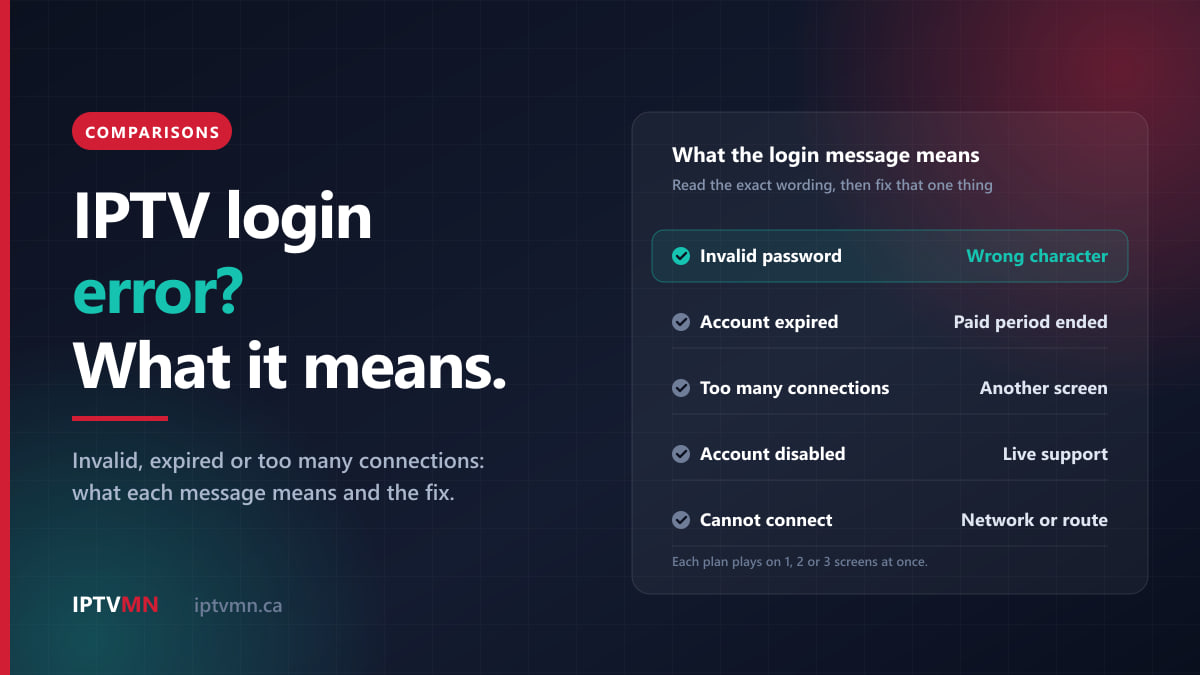
- “It says invalid login” or “too many connections.” Usually a typing mistake, an expired line or another screen still playing. Our guide to IPTV login errors explains every message, and the panel lets you check the line’s expiry date and reset the password yourself.
- “How do I put it on my TV?” You need to know the setup on the devices your customers own. The installation guides cover each one. Start with the Fire TV Stick, Samsung smart TVs and LG smart TVs.
- “It keeps freezing.” Often the home Wi-Fi rather than the service. A network cable to the box, or a router moved closer to the TV, fixes many of these. The help centre lists the short version of the common fixes, which is handy to send a customer.
- “When does mine run out?” The panel shows every expiry date and flags lines that are close to expiring.
If you supply or recommend devices, check the model before you buy several. Amazon’s newer Vega OS Fire TV Sticks cannot sideload apps, which most IPTV player setups need, and the Fire TV guide shows how to check which system a stick runs. Our comparison of the best device for IPTV sets out which sticks, boxes and TVs suit which households.
Set expectations in writing before you take anyone’s money:
- Your hours. People watch live sport in the evening and at weekends, so that is when problems show up. If you are not available on a Saturday night, say so up front.
- How to reach you, and how fast you reply. One channel that you actually check beats three that you do not.
- What happens at expiry. IPTV MN’s own retail plans never renew automatically. Decide whether you remind customers and how far ahead. A weekly look at the “close to expiring” list and a message a week before the date keeps renewals smooth.
- Your refund terms. Your customers buy from you, so their refund terms are yours to set and to honour. Your credits cannot be refunded, so make your first-week promise with that in mind.
- The household rule. IPTV MN’s terms and conditions keep login details personal to one household, and sharing them outside it can lead to suspension. Put the same rule in your own terms, so a customer does not pass a login around the street.
When something really is wrong on the network, escalate. Resellers get a support queue ahead of the standard one, direct access to the technical team when something needs investigating, and advance notice of maintenance so you can warn your customers first. Live support answers 24 hours a day, 7 days a week, and the email address is help@supportiptv.ca. Report specifics: which channels, which device, what time and how many customers are affected. A precise report gets a faster answer than “nothing works”.
Who is an IPTV reseller business not for?
A fair guide has to say when the answer is no. Reselling is probably the wrong move if any of these describe you:
- You want passive income. It is not passive. Every customer is a support relationship that lasts as long as they subscribe.
- You plan to compete on price alone. At $65 a year you keep $20 to $25 per customer, and someone can always go lower than you.
- You dislike tech support. If explaining how to type a password with a TV remote at 9 pm would annoy you once, it will annoy you every week.
- You would buy the biggest pack first. Spending $1,200 on non-refundable credits before you have a single customer is the surest way to lose money here.
- You want to sell access to your own subscription. Reselling a retail login breaks the terms and can get the account suspended without a refund. The reseller programme exists so you do not have to.
- You will not keep records. This is a business, with tax consequences, as the next section explains.
Is it legal to resell IPTV in Canada?
The technology is legal. IPTV is how Canadian carriers deliver their own television, including Bell Fibe TV and Rogers Ignite TV. What matters legally is the licensing of the content a service carries, not the delivery method.
IPTV MN supplies network access and reseller services and does not host, record or broadcast any media itself. Subscribers are responsible for making sure their own use complies with the Copyright Act and the Broadcasting Act. As a reseller you are a business selling to the public, so read the disclaimer and the terms carefully, understand exactly what you are selling, and take independent legal advice if anything about your plans is unclear. The what is IPTV page explains how the technology itself works.
Three practical rules keep a small reseller business on solid ground.
Advertise only what you can back up. The Competition Act makes false or misleading advertising illegal, and the Competition Bureau’s guidance on deceptive marketing applies to a one-person reseller as much as to a carrier. Do not promise a stream that never buffers, do not post reviews you did not receive, and do not make legal promises you cannot stand behind.
Register a business name if you trade under one. If you sell under any name other than your own legal name, most provinces require you to register it, and the rules and fees vary by province. The Government of Canada’s guide to registering a business name points to each provincial registry.
Know the GST/HST threshold. Under the Canada Revenue Agency’s small supplier rule, you must register for GST/HST once your taxable revenue passes $30,000 in a single calendar quarter, or over four consecutive calendar quarters. Below that, you may register voluntarily. Even 100 customers at $95 a year comes to $9,500, well under the threshold, but the profit is still business income and belongs on your tax return. Keep a record of every credit purchase and every customer payment from the first day, and ask an accountant if you are unsure.
How do you get started as an IPTV MN reseller?
According to the reseller page, getting set up usually takes no more than a day. Here is the order that avoids surprises:
- Test the service yourself first. Take the 24-hour free trial on your own TV at around 8 pm, when a live game is on and networks are busiest. You need to trust what you sell and know the setup by heart. No payment details are needed for the trial.
- Message the team. Tell live support or the sales address on the contact page roughly how many lines you expect to sell each month. There is no application form and no joining fee.
- Ask your pricing questions. Get the credit cost for each line length and connection count, find out which packs include sub-reseller accounts, and ask how to give your own prospects a trial.
- Buy your first credits by Interac e-Transfer. Send it from your bank app and the credits land in your panel immediately. Start with the 10-credit pack unless you already have customers waiting.
- Make your first line for yourself or a relative. Go through the whole customer experience, from creating the line to installing the app and extending it, before you sell to anyone else.
- Publish a short price list and your support terms. Then tell the people who already ask you for help with their TVs. They are your first customers.
Interac e-Transfer also works well for collecting from your own customers. Each payment arrives with a date and a name attached, which makes the record-keeping above much easier.
Three ways a reseller business can look in practice
These are illustrations built on the numbers above, not customer stories.
A computer-repair shop in Mississauga. Customers already bring in laptops and streaming sticks, and some ask about TV. The owner buys the 20-credit pack for $850, charges $95 for a one-screen year with setup done at the counter, and books house calls for homes with several TVs. Twenty lines at $95 bring in $1,900, which is $1,050 over the cost of the credits. The setup work is what those customers are paying for. See IPTV in Mississauga.
A retired electrician in Winnipeg. Neighbours in a seniors’ building keep asking for help with their TVs. They buy the 10-credit pack for $450, match the $78 retail price and set up eight neighbours over the winter. That brings in $624, so the pack has paid for itself with $174 to spare and two credits left over for next year. The real advantage is that every customer lives down the hall. See IPTV in Winnipeg.
A community organiser in Calgary. Newcomer families ask how to keep watching channels from home. Before selling anything, the organiser checks each family’s languages against the channels list, because a line without the one channel a family wants is a refund request waiting to happen. They price at $78, keep the margin modest, and put their effort into setting up each home in the family’s own language. See IPTV in Calgary.
In each case the business works because the reseller adds something the retail route does not: a counter to walk up to, a neighbour down the hall, or help in the right language.
Frequently asked questions
How much does it cost to become an IPTV reseller in Canada?
With IPTV MN there is no joining fee and no monthly minimum. The smallest pack is 10 credits for $450, or $45 a credit. The 20-credit pack is $850 and the 30-credit pack is $1,200. You pay by Interac e-Transfer, and the credits appear in your panel immediately.
Do IPTV reseller credits expire?
No. Unused credits carry forward indefinitely, so a quiet month costs you nothing. They cannot be refunded once issued, though, which is why starting with the smallest pack is the safer choice.
Can I set my own prices as a reseller?
Yes. You set your own retail prices and keep the whole margin. Bear in mind that IPTV MN’s retail prices are public, starting at $18 for a month and $78 for a one-screen year, so charging more than that needs a service, such as in-home setup, to justify it.
Do I need to register a business or charge GST/HST?
If you trade under a name other than your own, most provinces require you to register it. You must register for GST/HST once taxable revenue passes $30,000 in one calendar quarter or over four consecutive quarters, and you can register voluntarily below that. An accountant can tell you what applies to your situation.
Will IPTV MN deal with my customers directly?
No. Your customers buy from you and come to you for help, and IPTV MN does not contact them directly. Behind you, resellers get a priority support queue, direct access to the technical team and advance notice of maintenance.
Can I just resell my own subscription login?
No. Sharing or reselling retail login details outside your household breaks the terms and can lead to suspension without a refund. The reseller programme is the proper route for selling service to other people.
Start small, and charge for the service you give
An IPTV reseller business in Canada is a service business with a wholesale supplier behind it. The credits are the simple part: they cost $40 to $45 each, they never expire, and the panel handles the rest. The work is support, and the margin is best when you charge for that support rather than competing on price.
If you are still weighing it up, start with the service itself. Take the free trial, set it up on the devices your future customers own, and compare what they would pay by going direct on the pricing page. When you are ready to talk numbers, the reseller programme page explains the next step, and the team will answer your credit questions before you buy anything.
Written by the IPTV MN team
We run the servers in Toronto and Montreal and answer the support messages. Everything here comes from what we see on the network and what Canadian members actually ask us. Something unclear or out of date? Tell us and we will fix it.
Keep reading
Comparisons 14 min read
IPTV Login Error? What Invalid Account, Expired and Too Many Connections Mean (2026)
IPTV login error? Learn what invalid account, expired and too many connections messages really mean, the fix for each, and how connection limits work.
Read the guide
Comparisons 17 min read
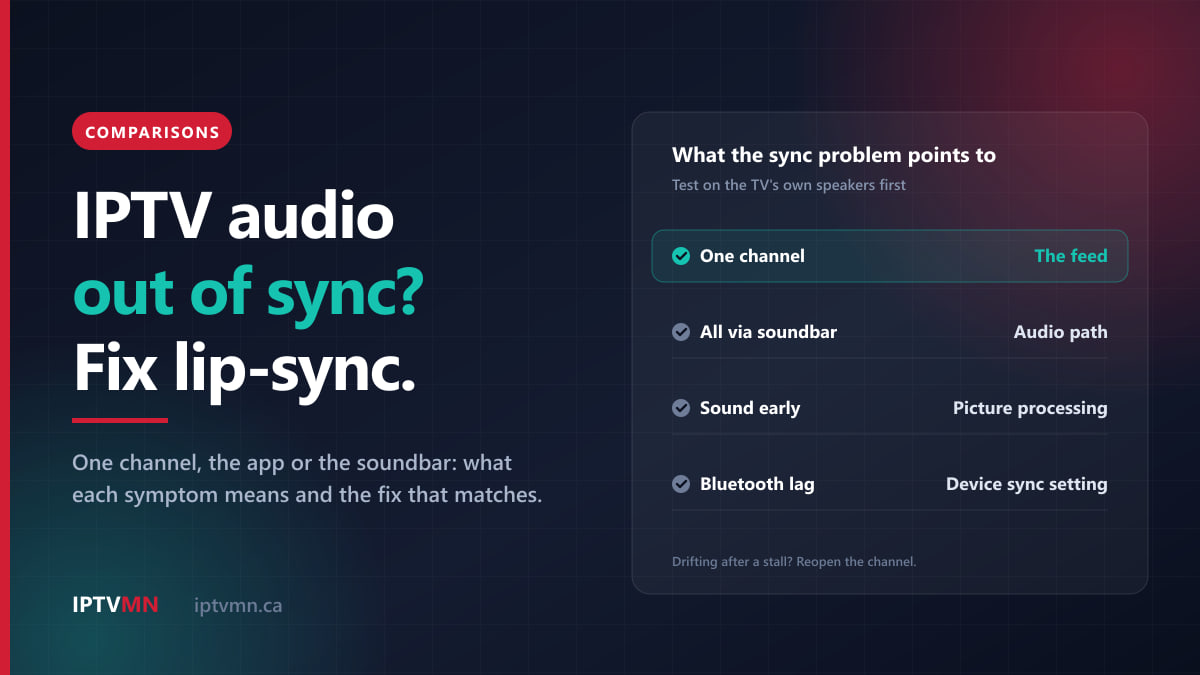
IPTV Audio Out of Sync? How to Fix Lip-Sync Delay on Any TV (2026)
IPTV audio out of sync? Find out whether the delay comes from the channel, the app or your soundbar, and fix lip-sync in minutes on Fire TV, Samsung and LG.
Read the guide
Comparisons 16 min read
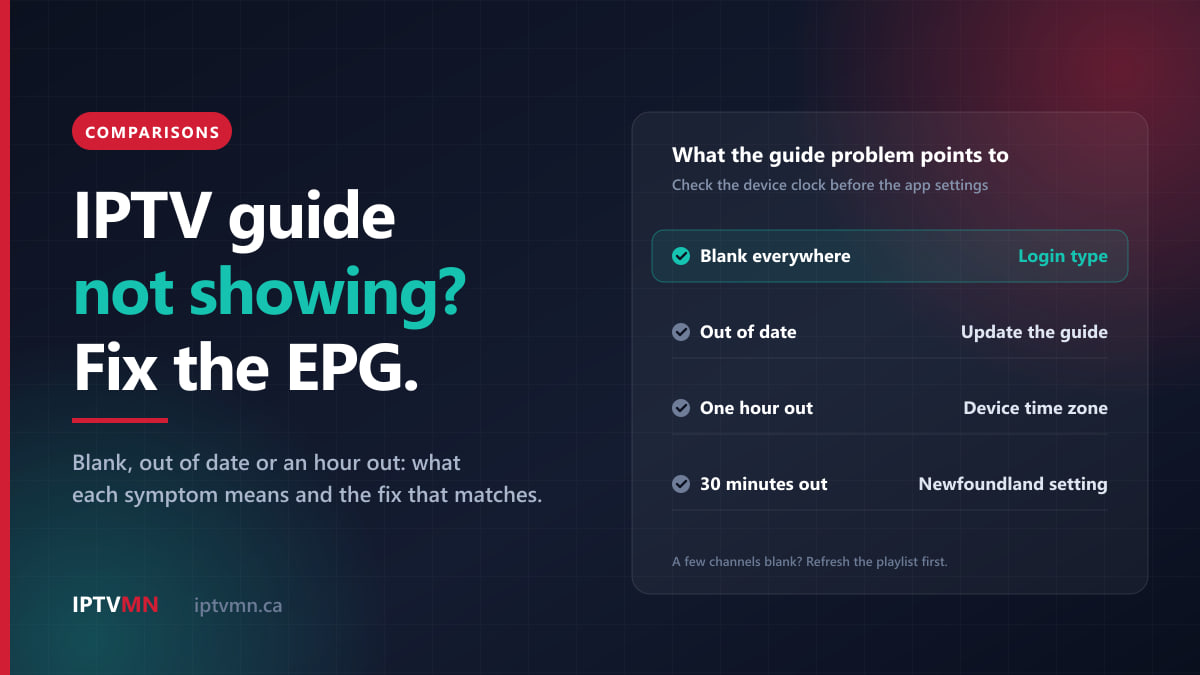
TV Guide Not Showing on IPTV? How to Fix a Blank, Stale or Wrong EPG (2026)
IPTV EPG not working? Find out why the TV guide is blank, out of date or an hour out, and fix it in minutes: login type, refresh, time zone and cache.
Read the guide