Comparisons
Is IPTV the Best Choice in Canada? An Honest Verdict for 2026
Is IPTV the best way to watch TV in Canada? We weigh it against cable, satellite and streaming apps on cost, sports, quality and reliability.
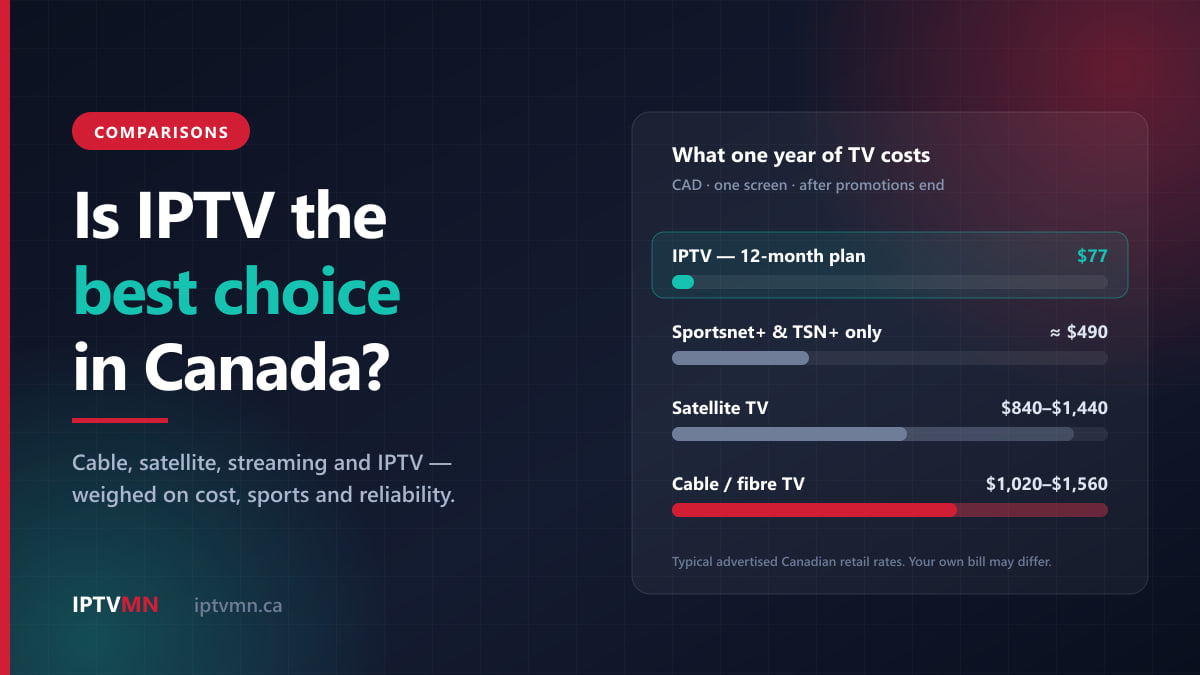
For most Canadian households that watch live television, and especially live sports, IPTV is the best-value way to do it in 2026. It is not the best choice for everyone, though, and the homes it does not suit are easy to recognise.
This guide sets out both sides with real numbers, so you can decide for your own home instead of taking anyone’s word for it. That includes ours.
The short answer
IPTV is probably the best choice for you if most of these are true:
- You watch live channels, not only on-demand shows.
- You follow Canadian sports and are tired of paying for several apps to see every game.
- Your home internet runs at 15 Mbps or faster and is reasonably steady.
- You want no contract, no receiver rental and no technician visit.
- You are comfortable installing an app on a TV, a streaming stick or a phone. It takes about five minutes.
It is probably not the best choice if:
- Your internet is slow, drops out often, or sits on a tight monthly data cap.
- You only ever watch one or two on-demand services and never live TV.
- You live somewhere with no usable broadband, where satellite is the only option.
- You want every channel billed through one regulated Canadian carrier, bundled with your phone and internet.
The rest of this article explains why each of those points matters, and how much.
What “the best choice” actually means
“Best” is not one number. When Canadian households compare their options, five things decide it:
- Total cost over a year. Not the promotional price, but the price after the promotion ends.
- Live sports. Whether every game you care about is actually on, including the regional feeds.
- Breadth. How many channels, languages and on-demand titles you get for that money.
- Picture and reliability. How the stream looks, and whether it holds up during a big game.
- Flexibility. Contracts, equipment, the number of screens, and whether it works when you travel.
A service that wins on price but fails on reliability is not the best choice. Neither is one that works perfectly but costs $1,500 a year. Every option below is scored on all five.
The four ways Canadians watch TV in 2026
| IPTV subscription | Cable or fibre TV | Satellite TV | Streaming apps | |
|---|---|---|---|---|
| Typical cost | $6.42–$17 a month | $85–$130 a month after promo | $70–$120 a month | Each app billed separately |
| Contract | None | Often two years | Often two years | None |
| Live channels | Thousands | 150–250 in a package | 200–400 in a package | A handful, app by app |
| Every regional sports feed | Yes, on a good service | Only what your tier includes | Only what your tier includes | Split across Sportsnet+ and TSN+ |
| Equipment | A device you already own | A rented receiver per TV | A dish plus a rented receiver | A device you already own |
| Installation | You, in about five minutes | Technician visit | Technician and dish alignment | You |
| Affected by weather | No | No | Yes, rain and snow fade | No |
| Works away from home | Yes, anywhere with internet | No | No | Mostly, within Canada |
| Needs home internet | Yes | Fibre TV does; older coaxial cable does not | No | Yes |
One detail in that table surprises people: Bell Fibe TV and Rogers Ignite TV are themselves IPTV. Canada’s two largest carriers moved their own television products onto internet delivery years ago. The technology is not the fringe option; it is the mainstream one. What differs between services is price, lineup and how well they are run.
The cable and satellite figures are typical advertised Canadian retail rates once introductory pricing ends. Your own bill may differ, and our line-by-line breakdown of a real cable bill shows where the money goes.
Where IPTV is the best choice
1. Cost: the gap is large, and it does not expire
This is where the comparison is least close. A twelve-month single-screen IPTV plan costs $77, which works out to $6.42 a month. A single month is $17, and a two-screen year is $127. The full list is on the pricing page.
A cable package at $85 to $130 a month costs $1,020 to $1,560 a year. Once you add the receiver rentals and the sports tier most households end up paying for, a typical mid-tier bill lands at around $1,530. Against $77, that is roughly $1,450 a year left in your account.
There is also no promotional cliff. Cable pricing is built around a low first-year rate that rises when the promotion ends, which is why the number people remember is rarely the number they pay. An IPTV plan has one price, paid up front for the period you choose, with no auto-renewal and nothing that jumps in month thirteen.
2. Live sports: every feed, in one place
Canadian sports rights are split. Bell owns TSN and RDS, Rogers owns Sportsnet, and TVA Sports carries a share of the French-language coverage. On top of that, both TSN and Sportsnet run regional feeds: TSN 1 to 5, and Sportsnet East, Ontario, West and Pacific. Your local team’s regional games sit on one of those feeds, and the other feeds are often blacked out where you live.
That split is what makes sports expensive everywhere else:
- Cable gives you the feeds in your tier and your region. Out-of-market games usually need a more expensive package.
- Streaming means buying Sportsnet+ and TSN+, about $490 a year together, and still missing the French feeds.
- IPTV MN carries all five TSN feeds, every Sportsnet regional feed plus Sportsnet One, 360 and World, and both TVA Sports and RDS in French, in one subscription.
Carrying every regional feed is what stops a regional blackout from hiding a game. If hockey is the main reason you watch, our guide to watching the NHL in Canada without cable goes through which games land on which feed.
3. Breadth: far more than a carrier package
A Canadian cable package carries 150 to 250 channels. An IPTV subscription carries thousands: IPTV MN lists more than 54,000 live channels, alongside a library of more than 195,000 movies and 45,000 TV shows on demand.
Most households will never watch most of those channels, and that is not really the point. The point is that the few channels you care about are almost certainly in there. That might be a French-language news channel in Vancouver, a home-country channel for a family that moved to Canada, a UK football channel, or a specialty network no Canadian package carries. You can check the full lineup on the channels list before you spend anything.
Smart EPG and catch-up TV come with every plan, so the guide shows what is on, and you can go back to a programme you missed.
4. Flexibility: no contract, your own devices, anywhere
There is no contract, no auto-renewal and no cancellation fee. You buy a period, it runs, and it stops. If you want to continue, you renew.
A connection means one screen watching at a time. You can install the app on as many devices as you like, but a one-connection plan plays on one screen at once. Plans come with one, two or three connections, so a household can match the plan to how many people actually watch at the same time.
It works on the hardware most Canadian homes already own. The installation guides cover the Amazon Fire TV Stick, Samsung smart TVs, LG, Android TV, Apple TV, Chromecast, Roku and Windows PCs. Many recent televisions need no extra box at all, as our guide to IPTV on a smart TV without a box explains.
It also travels. Your login works on any internet connection, so Canadians who winter in Florida or Arizona keep their home channels, their guide and their favourites. The programme guide handles all six Canadian time zones, including Newfoundland’s half-hour offset and Saskatchewan’s refusal to change clocks. There is more on that on the coverage page.
5. Picture quality and speed
The honest version first: not every channel is 4K. Most live television around the world is still broadcast in HD or Full HD, and no service can make a 1080p broadcast into a true 4K one. What a good IPTV service can do is deliver 4K wherever the source is 4K, which covers selected live events and a large share of the on-demand library, and deliver everything else at its full original quality.
Where servers sit matters just as much. IPTV MN delivers from data centres in Toronto and Montreal, so the path from a Canadian home is short. A channel opens in about two tenths of a second, and a free backup server comes with every subscription in case one route has a problem. Services that stream to Canada from overseas servers are the main reason IPTV has a reputation for buffering. If you do see it on your own connection, the buffering fixes guide walks through the causes in order.
Where IPTV is not the best choice
A fair answer has to include the cases where the answer is no.
Your internet is slow or unsteady
IPTV is television delivered over your internet connection, so the connection sets the ceiling. As a rough guide:
| Picture | Speed needed per screen |
|---|---|
| HD (720p) | 8–12 Mbps |
| Full HD (1080p) | 15–20 Mbps |
| 4K | 25–40 Mbps |
If two screens watch at once, add the numbers together. Steadiness matters more than the peak figure: live television has almost no buffer to fall back on, so a connection that is fast but drops out every few minutes is worse than a slower one that holds. A wired Ethernet connection to the main television fixes more problems than any upgrade.
You are on a tight data cap
Most Canadian home internet plans are unlimited now, but some rural, fixed-wireless and budget plans are not. A handy conversion: each Mbps of streaming uses about 0.45 GB per hour.
- HD at around 10 Mbps is about 4.5 GB an hour.
- 4K at 25 to 40 Mbps is about 11 to 18 GB an hour.
Three hours of HD every evening adds up to roughly 400 GB a month. On an unlimited plan that is irrelevant. On a 200 GB plan it is not, so check yours before you commit.
You only watch one or two on-demand services
If your viewing is entirely Netflix originals, or one other on-demand app, a single subscription to that app is simpler. IPTV earns its place with live television: news, sports, and the channels you flip through in the evening. Plenty of households keep one on-demand app alongside an IPTV plan, because the two do different jobs.
There is no usable broadband where you live
Satellite remains the right answer for homes with no broadband at all, because it does not depend on an internet connection. That group is shrinking fast, though. Many rural members run IPTV on fixed wireless, rural fibre or Starlink without trouble, so if you already have one of those, you are not in this group.
You want one regulated bill
Some households simply prefer their television to come from the same carrier as their phone and internet, on one bill, with the channels licensed and billed through that carrier. That is a legitimate preference, and they are paying for it knowingly. If it is yours, cable or fibre TV is the better fit.
Is IPTV legal in Canada?
The technology is entirely legal. It is the same technology Bell and Rogers use for Fibe TV and Ignite TV. What matters legally is the licensing of the content a particular service carries, not the delivery method.
IPTV MN supplies network access and reseller services and does not host, record or broadcast any media itself. Subscribers are responsible for making sure their own use complies with the Copyright Act and the Broadcasting Act of Canada. The full position is set out in our disclaimer, and the what is IPTV page explains how the technology itself works.
IPTV against each alternative
IPTV vs cable or fibre TV
IPTV wins clearly on cost, sports breadth, contracts and equipment. Cable wins on one thing: some older coaxial services keep working when your internet is down. For a household with steady internet that watches sports, IPTV is the better choice at roughly a twentieth of the yearly cost.
IPTV vs satellite
Satellite’s advantage is independence from broadband, and its weakness is the weather. Rain and heavy snow cause signal fade at exactly the moments people most want to watch, and the dish and receiver come with rental fees and a contract. Anyone with a usable broadband connection will be better served by IPTV.
IPTV vs streaming apps
These are less competitors than neighbours. Streaming apps are strongest for their own original shows; IPTV is strongest for live channels and sports. Where they do overlap, on sports, stacking Sportsnet+ and TSN+ costs several times an IPTV year and still leaves gaps. Many households keep one favourite streaming app and let IPTV handle everything live.
Six Canadian households, six verdicts
A hockey family in Edmonton. They want every Oilers game, including the regional broadcasts on Sportsnet West, plus the national games. Verdict: IPTV, because every regional feed is in one subscription. See IPTV in Edmonton.
A francophone couple in Montreal. RDS, TVA Sports and French-language news are non-negotiable, and so is a guide in the right time zone. Verdict: IPTV, which carries both French sports networks that streaming leaves out. See IPTV in Montreal.
A student in Halifax on a tight budget. They watch on a laptop and a phone, mostly during exams and the playoffs. Verdict: IPTV, month by month. A $17 month when it is wanted, nothing when it is not, and no contract to break. See IPTV in Halifax.
A newcomer family in Mississauga. Home-country channels for the parents, Canadian news for everyone, cartoons for the children. Verdict: IPTV, because no Canadian package carries that mix. See IPTV in Mississauga.
Retired snowbirds from Ottawa. Six months in Ottawa, the winter in Florida, and they want the same channels in both places. Verdict: IPTV, because the login works on any connection in either country. See IPTV in Ottawa.
A rural household on a 10 Mbps capped plan. One television, a 150 GB monthly cap, and no other option available yet. Verdict: not yet. One HD screen may work, but the data cap will be tight. The free trial is the honest way to find out before paying anything.
How to tell whether a particular IPTV service is a good choice
The technology being right does not make every seller right. The Canadian market is full of services that are cheap for a reason. A good one should pass every item on this list:
- Servers in Canada, not overseas, so channels start quickly and hold up at peak hours.
- Every regional sports feed: TSN 1 to 5, every Sportsnet regional feed, RDS and TVA Sports.
- A programme guide that is correct for Canadian time zones all year round.
- A free trial with no card required, so you can test it on your own connection first.
- A written refund policy you can read before paying.
- Canadian payment in CAD, such as Interac e-Transfer, so no card is stored and there is no foreign exchange fee.
- No auto-renewal, so nothing is charged without you asking.
- A real support channel that answers, and a backup server for when one route fails.
Our guide on how to choose the best IPTV in Canada goes through each of these in detail. If you are unsure which login format to use, Xtream Codes vs M3U explains the difference, and do you need a VPN for IPTV in Canada answers the question most people ask next.
How to test it before you decide
The only test that really settles the question is watching on your own television, on your own internet, at the busiest time of the evening. Here is the low-risk way to do it:
- Request a 24-hour free trial. No card is needed. Ask through live support or the free trial page.
- Install the app on your main television using the setup guide for your device.
- Watch a live game at around 8 pm. That is peak time on Canadian networks, and the fairest test of any service.
- Check the channels you actually care about, not the headline count: your local news, your team’s regional feed, your language.
- If it holds up, pick a plan. Pay by Interac e-Transfer from your bank app and your login arrives by email in under ten minutes. The IPTV subscription page sets out exactly what you receive.
If something goes wrong after you buy and it cannot be fixed on your setup, the refund policy gives you seven days to get your money back.
Frequently asked questions
Is IPTV better than cable in Canada?
For most households with steady internet, yes. It costs a small fraction of a cable package over a year, carries every regional sports feed rather than only those in your tier, and has no contract or rented equipment. Cable keeps an advantage only for homes without reliable internet.
Is IPTV worth it if I already pay for Netflix?
Usually yes, because the two do different jobs. Netflix is on-demand originals; IPTV is live channels, news and sports, plus a large on-demand library of its own. Plenty of households keep one streaming app and use IPTV for everything live.
What internet speed do I need for IPTV?
About 8 to 12 Mbps for HD, 15 to 20 Mbps for Full HD and 25 to 40 Mbps for 4K, per screen. A steady connection matters more than a fast one, and a wired connection to your main television helps most of all.
Can IPTV replace cable for live sports?
Yes, and for sports it is the strongest option in Canada. A good service carries all five TSN feeds, every Sportsnet regional feed, RDS and TVA Sports together, which neither a single cable tier nor the Sportsnet+ and TSN+ apps manage on their own.
Does IPTV work on a smart TV without a box?
On most recent Samsung, LG, Android TV and Google TV sets, yes. You install an app directly on the television and sign in. Older sets without app support need an inexpensive streaming stick.
What happens if my internet goes down?
The television stops too, exactly as it would with Fibe TV, Ignite TV or any streaming app. Satellite is the only option that keeps working without broadband. For an important game during an outage, the same login works on a phone over mobile data. Just keep an eye on how much data you use.
The verdict
For most Canadian homes with a steady connection and an interest in live television, IPTV is the best choice in 2026. It leads clearly on cost and on sports coverage, and it matches cable on nearly everything else. The one thing it cannot do is work without the internet.
It is the wrong choice for homes on slow or tightly capped connections, and for people who only ever watch one on-demand app. Everyone else can find out risk-free: take the free trial, watch a game at 8 pm on your own television, and decide with your own eyes. When you are ready to compare the market properly, our page on the best IPTV in Canada sets out the standard to hold any provider to, including us.
Written by the IPTV MN team
We run the servers in Toronto and Montreal and answer the support messages. Everything here comes from what we see on the network and what Canadian members actually ask us. Something unclear or out of date? Tell us and we will fix it.
Keep reading
Comparisons 7 min read
IPTV vs Cable in Canada: What You Really Pay Over One Year
A line-by-line comparison of a Canadian cable bill against an IPTV subscription. Equipment rental, promo cliffs, sports add-ons and the real annual total.
Read the guide

Guides 28 min read
How to watch IPTV on a Smart TV in Canada without a box
Learn which Smart TVs in Canada support IPTV apps directly and how to set up IPTV MN without an external box or extra hardware.
Read the guide
Troubleshooting 8 min read
IPTV Buffering? Nine Fixes That Work in Under Five Minutes
Why IPTV streams stutter and how to stop it. Router placement, Ethernet, decoder settings, DNS and the backup server — in order of what fixes it most often.
Read the guide